
The Future of Supply Chain Disputes Is a Proof Problem

Trade remedies, export control compliance, AI-enabled systems, and geopolitical disruption are turning supply chain risk management into an evidence, audit, and litigation issue.
The next generation of supply chain disputes will not—as has long been the case—turn only on whether goods arrived late, costs increased, or a supplier failed to perform. It will instead turn on substantive evidence: whether companies can prove how goods moved, where inputs originated, and who controlled the counterparties; and whether sanctions and export-control risks were assessed, artificial intelligence (AI)-enabled supply chain tools made defensible decisions, and management acted before disruption became revenue loss.
Why the shift? Intensifying trade and customs enforcement measures find that a wide range of behaviors—from customs misstatements, tariff evasion, and origin fraud to procurement certifications, sanctions-related representations, and government-contract claims—can move quickly from administrative matters into litigation and criminal liability.
The mounting threat of two key policy instruments helps prove the point. Settlements and judgments under an expanded FCA hit a record high in fiscal year 2025, driven in large part by an increase in privately filed whistleblower actions. If BIS allows the suspended Affiliates Rule to take effect again in November 2026, Washington would have a broader export-control tool against circumvention networks by extending certain restrictions to foreign entities owned 50 percent or more by covered listed parties. The practical effect would be restricted-party screening and licensing exposure well beyond named listed entities, including potentially thousands of off-list affiliates worldwide. (The rule would extend certain Entity List, Military End-User List, and Specially Designated Nationals-related export administration regulation restrictions to foreign entities owned 50 percent or more, directly or indirectly and individually or in the aggregate, by covered listed parties.)
Today’s escalated enforcement landscape also could lead to a range of disputes. Insurers may use these regulatory policies as grounds for denial. Banks could withhold loan payments. If a supplier’s supplier is affiliated with a sanctioned entity, liability easily could boomerang back to the original purchaser. It’s everything everywhere all at once, a regulatory porcupine where if you miss one needle, you’ll likely get pricked by another.
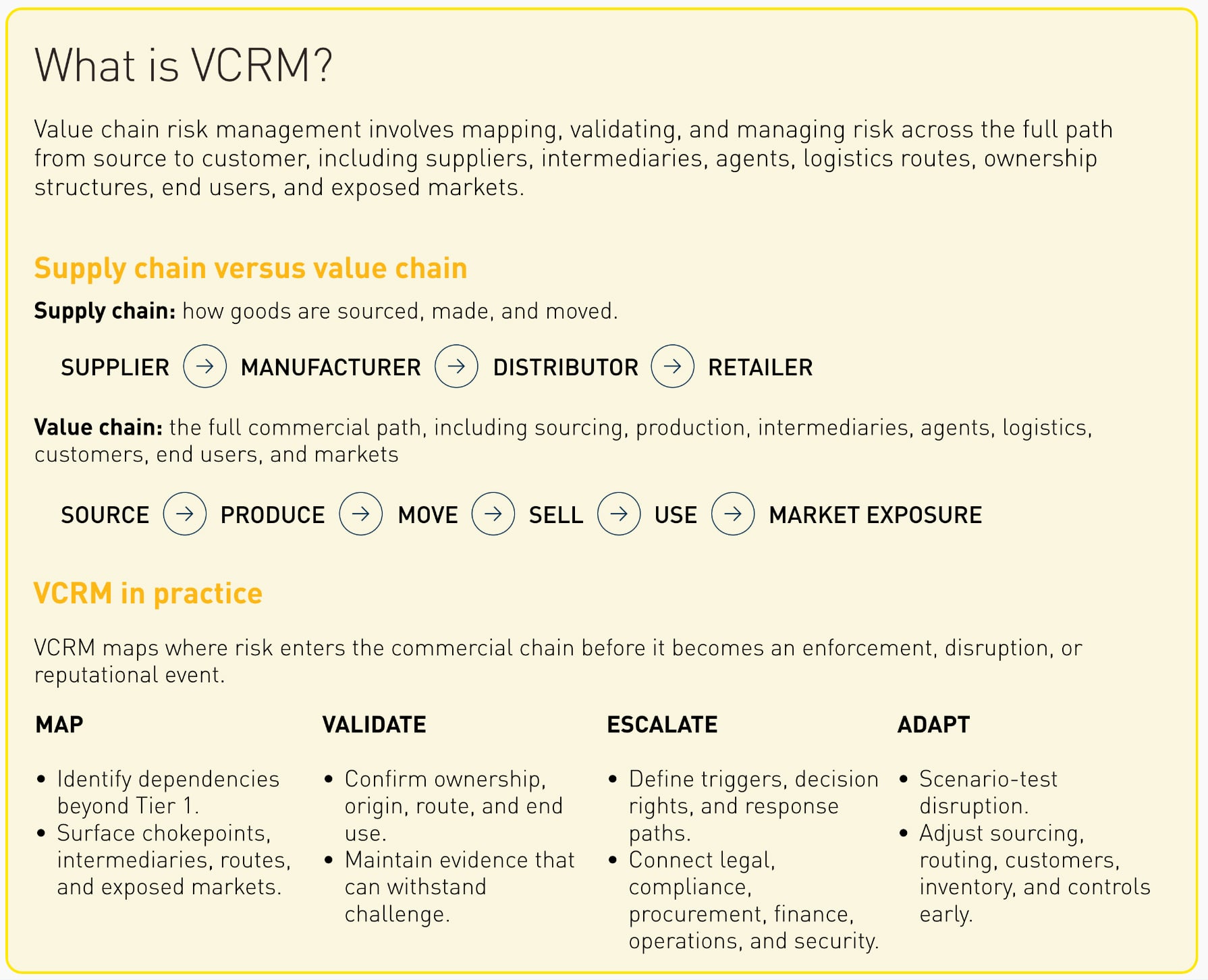
The practical question for boards and counsel is not merely “Can we keep supply moving?” but “Can we reconstruct and defend the decisions that kept it moving?” Fortunately, the VCRM framework gives companies an operating model by connecting sourcing, logistics, finance, insurance, customers, markets, and—crucially—evidence.
Four Emerging Supply Chain Dispute Trends—and How VCRM Can Help
A heightened trade and customs enforcement climate—including higher tariffs, expanded sanctions, tighter export controls, new forced-labor restrictions, and steeper trade remedies—is changing the dispute profile of global supply chains. Geopolitical disruption and AI-enabled supply chain tools are adding another layer: companies increasingly have to prove not only what happened but also what they knew, what their systems showed, and how decisions were approved.
Below, we discuss emerging dispute trends that show how adopting a VCRM framework can help executives mitigate and manage operational risk before it becomes contractual, regulatory, enforcement, or litigation exposure.
1) Proof will matter more than visibility.
Traditional supply chain visibility is no longer enough. A company may know its tier 1 supplier but still be unable to prove origin, ownership, control, routing, end use, labor integrity, or sanctions permissibility. Parties to a potential dispute will now ask for evidence, not merely summary dashboards of a given enterprise resource platform (ERP) system.
In a customs detention, sanctions inquiry, tariff dispute, insurance claim, government-contract review, or FCA matter, for instance, the company will need to show what it knew, when it knew it, what records supported the decision, and who approved the transaction. If supplier attestations, ERP records, bills of lading, bills (and software bills) of materials , certificates of origin, screening results, purchase orders, payment records, vessel data, AI tool outputs, and audit files do not tell the same story, the inconsistency becomes an investigative lead.
VCRM best practice: A VCRM operating model helps executives move beyond supply chain mapping to evidence preservation, including documented origin, ownership, route logic, supplier diligence, customer diligence, escalation history, and management decision records.
2) Enforcement pressure will increase counterparty deception.
As enforcement pressure rises, companies and intermediaries will try to preserve margins or market access by changing paperwork rather than conduct. This will create risk for the buyers, importers, manufacturers, financial institutions, insurers, and government contractors that rely on representations that may prove false or misleading.
This issue is not limited to intentional misconduct by the company. A supplier, broker, distributor, customer, or logistics intermediary can introduce exposure by falsifying origin, obscuring ownership, routing goods through third countries, or using shell entities to bypass sanctions, tariffs, export controls, or procurement restrictions. The FCA, particularly its qui tam provision, deepens the risk calculation because alleged customs, procurement, sanctions, or sourcing misrepresentations may surface through whistleblowers, competitors, counterparties, or former employees.
VCRM best practice: VCRM treats deception risk as a foreseeable operating condition in stressed value chains. Companies should validate supplier claims, check ownership and control, test origin and route logic, preserve escalation records, and identify where cost pressures create incentives to misstate facts. These practices align with the VCRM view that all third parties can carry risk.
3). Disruptions will become supply chain disputes faster.
Supply chain disruptions were once managed mainly through logistics, procurement, and customer-service channels.
But in today’s environment a delayed shipment is not always a logistics problem. If a delayed shipment is tied to a customs hold, sanctions review, route change, war-risk exclusion, force majeure notice, supplier substitution, tariff shock, or questionable origin claim, for example, the dispute can move quickly from operations to legal. Counterparties will ask who bore the risk and whether the delay was foreseeable, alternatives were available, notice was timely, the company mitigated loss, and any representation was accurate when made. The answer will often sit across legal, procurement, logistics, finance, trade compliance, and risk systems.
Issues surrounding the Strait of Hormuz illustrate this dynamic. Though it is in the process of reopening physically as of this writing, it could remain commercially degraded for some time, preserving risk premia across shipping, energy, fertilizer, and trade finance. A physical routing problem can therefore become a contract, insurance, pricing, delivery, or disclosure dispute.
VCRM best practice: VCRM helps companies treat disruption as a cross-functional risk. That means mapping route dependencies, identifying contractual risk-transfer points, documenting mitigation options, preserving notice and escalation records, and testing whether alternative suppliers, routes, insurers, and payment channels are realistic before a dispute arises.
4). AI in the supply chain will create a new audit-rights problem.
Companies are adopting AI tools for supplier scoring, sanctions screening, route optimization, demand forecasting, inventory allocation, trade classification, labor-risk scoring, and procurement decisions.
Yet these systems create their own evidence problems. If an algorithm recommends a supplier, approves a route, downgrades a sanctions alert, assigns a labor-risk score, classifies a product, or allocates scarce inventory, counsel may later need to explain why the system reached that result. This requires more than typical comfort with a given vendor. Companies need audit rights, model documentation, data-source transparency, change logs, exception records, cybersecurity controls, and human override procedures. A black-box system may be operationally efficient but is a weak witness.
These issues are surfacing in litigation. In at least one expert-discovery dispute, a court ordered the disclosure of AI prompts or queries an expert or her team had used in preparing an expert report. Though the broader discovery treatment of AI prompts, outputs, model documentation, and related logs remains context-specific, the direction is clear enough for companies to plan for it.
VCRM best practice: AI vendors should be treated as critical value-chain dependencies. Their models, data sources, cybersecurity posture, audit rights, change logs, exception records, and decision logs should be governed with the same discipline applied to other high-risk third parties. This fits the VCRM control logic around digital resilience, traceability, evidence integrity, monitoring, escalation, and response.
VCRM Is the Operating Answer
Most supply chain discussions still focus on efficiency and resilience. Those priorities matter but often stop short of the full value chain: suppliers, intermediaries, logistics routes, customers, end users, and exposed markets. That gap matters as enforcement pressure, geopolitical disruption, and AI-enabled tools turn more disputes into questions of evidence, auditability, decision rights, and control.
Companies can position themselves for this environment by connecting visibility to proof and response: mapped dependencies beyond tier 1, validated ownership and origin, tested route and transaction logic, preserved records, clear escalation triggers, and sourcing, insurance, financing, customer, and inventory decisions made before a dispute hardens.
The VCRM framework gives companies a way to reconstruct transactions, explain decisions, identify approvals, and produce the record needed when a customs detention, sanctions inquiry, insurance claim, government-contract review, or litigation demand arrives.
The stakes are high. Companies that can’t provide substantive proof may solve the commercial problem but lose the evidentiary one.

